Insight

Lessons from Mega-Events: Procurement Pitfalls

Articles

Mega-events such as the Olympics, the World Cup or music festivals are fixed-duration occasions with global outreach and large audiences. These events demand significant infrastructure which frequently exceed USD 10 billion, occupy hundreds of hectares and mobilise thousands of contractors across multiple jurisdictions. Intense, immovable deadlines often lead to cost overruns and schedule slippages. For instance, since 1960 the Olympic Games have, on average, exceeded their budgets by an estimated 179 percent.

A principal driver of these outcomes is selecting an ill-suited procurement and contract strategy. There are various procurement methods, each with its own strengths and weaknesses. The most appropriate method depends on factors including the required completion date, the complexity, nature and scale of the project, budget, owner expertise, the need for design control, the importance of cost certainty and flexibility, and the parties’ appetite for risk. For example, the traditional design-bid-build approach tends to place more risk on the owner than the design and build approach.

Common Procurement Models

ExplanationAdvantagesDisadvantages
Design-Bid-Build (DBB)

Separate contracts for design and construction, carried out by different parties, with very little overlap.

• Owner appoints consultants to design, the contractor to construct, and a project manager to administer the building contract.
• Competitive tender is based on detailed design documents provided by the Owner.
• A DBB contract can be priced in multiple ways:
1. Lump Sum price – contract sum is determined before construction starts.
2. Guaranteed maximum price (GMP) – unless the Owner requires a change to the project, they will not pay the Contractor more than the guaranteed maximum price (e.g. the Millenium Stadium in Cardiff, Wales).
3. Measurement contract – the Owner pays pays for expected work levels with later reconciliation by a quantity surveyor based on actual quantities.
• Certainty of construction period and, in a lump sum or GMP contract, contract price.
• Detailed contract documents can specify exact requirements, therefore ensuring higher quality. Indeed, the UEFA Guide to Quality Stadiums envisages this procurement model for this reason.
• Clear liability separation.
• Enables competitive pricing.
• Certain standard forms, such as JCT, allow a “Contractor designed portion” to transfer specific design liability downstream.
• Longer duration because design needs to be completed before tender bids are made and construction commences.
• Any changes may cause delay and increase cost.
• Additional fees are paid to consultants.
• High level of precision required in the technical documents.
• Limited flexibility.
• Not involving the contractor early forfeits constructability input that can yield programme and cost efficiencies.  
Design-Build (DB)
Single contract covering design and construction, pursuant to which the Contractor is responsible for both design and construction.

• Contractor makes proposals in response to the Owner’s “employer’s requirements”.
• Contractor is responsible for the performance of any sub-contractors, whether or not they carry out any design. This is known as the “single point of responsibility”.
• Certainty of construction period and lump-sum price.
• Owner can monitor the Contractor’s performance.
• Single point of responsibility can help manage Owner’s requirements and make claims easier.
• The Owner’s responsibility for design defects is limited by transferring risk to the Contractor and their consultants.
• Reduced Owner control. Can prove more costly with increased delay in the long run with variations.
• Higher quality risk if the performance specifications are vague.
• Higher cost associated with transferring more design risk to Contractor.

Lump Sum Turnkey
Variant of DB where the Contractor handles all elements of the building project
The advantages and disadvantages are similar to DB, however, the following is worth considering when choosing between DB and Lump Sum Turnkey:

Control: suits owners who don’t want to be involved in everyday management – i.e. less hands-on than DB.

Level of responsibility: Contractor tends to have more responsibility than in a DB contract.

Time: tend to be slightly faster because the construction team can work more efficiently and manage their own time and labour allocation.

Cost: can be more expensive than DB projects because the Contractor takes on more of the risk.
Management Contracting

• Owner appoints a management contractor and consultants. During the pre-construction phase, the works packages are developed from the drawings, specification and cost plan. Those packages are then let out by competitive tender.
• The management contractor appoints works contractors and manages construction but does not perform the works. The Owner retains design control and usually enters into client/works contractor agreements to obtain warranties directly from works contractors.  
• Since the Owner appoints the consultants, it retains design control throughout the project.
• Flexibility. Management contractor and design team can work together to meet the Owner’s requirements and design changes can be developed.
• Often quicker because design and construction can progress in parallel.  
• No certain construction period or price.
• Complicates tender comparisons because management fees are often a percentage of costs.
• Owner carries a lot of risk. One way of re-assigning this to the management contractor is to insist that the reimbursement of subcontractors will be subject to a maximum tender figure such that any cost overrun (except for agreed variations) will be the responsibility of the management contractor
Public-Private Partnership (PPP)
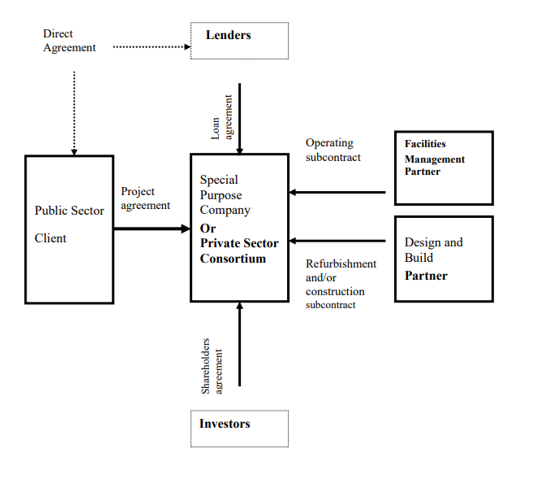
Collaboration between a government agency and a private sector company (typically an SPV) used to finance, construct and operate the Project. A simplified typical structure is as follows:


The SPV usually has few resources of its own and so it will sub-contract most of its obligations.
• Clear risk allocation and management.
• Long commercial relationship, encouraging better performance.
• Budget and delivery certainty.
• Innovation and efficiency from private expertise.
• More complex with higher upfront transaction, capital and financing costs and longer procurement times.
• Long term costs often exceed initial estimates.
• Harder to negotiate and administer the complex contracts.
• Contractual rigidity, making modification difficult if Owner’s needs change.
• Greater political exposure.
• Increased scrutiny from government Owner.

Case Studies

The key to successful procurement strategy selection is prioritising the Owner’s objectives and planning the best path to deliver those objectives on time, within budget and to the required specification. It is also imperative that the form of contract used supports the procurement method and that it is clearly drafted so as to capture the parties’ intentions and risk allocation.

The following examples illustrate good and bad procurement choices.

Wembley Stadium, London

In 2002, Wembley Stadium was demolished to make way for new 90,000 seat-venue which is now the second largest stadium in Europe, crowned by the iconic load-bearing steel arch. Despite standing today such an iconic facility, Wembley’s redevelopment was marked by extensive delays, cost overruns and disputes. It serves as a stark reminder that misaligned procurement decisions create a difficult landscape and amplify risk and friction across the whole supply chain.

Wembley National Stadium Limited (WNSL), the owner, adopted a design-build model with a GMP contract. Believing the project was well defined with few anticipated changes, WNSL selected a structure intended to prevent overspend. In practice, these choices shifted extensive design and delivery risk to the main contractor, Multiplex, before design maturity had been reached. This curtailed flexibility around budget and scope and incentivised defensive contract management. Some major bidders withdrew at tender due to the aggressive risk profile, foreshadowing the adversarial environment that followed.

As designs evolved post-award, Multiplex’s scope was repeatedly revisited, triggering over 560 design changes. The combination of an incomplete design at contract formation, a fixed-price ceiling and a stringent change mechanism created systemic pressure on programme and budget, culminating in delay, cost overrun and commercial dispute. During tender, construction costs were estimated at £326.5 million, rising to £445 by contract award and £798 million at completion. Likewise, the target completion date was originally May 2003, yet work only commenced in October 2002 and work was completed in March 2007. Multiplex announced losses exceeding £180m and the project spiraled into multiple disputes.

Downstream, supplier selection and interface management magnified problems. The relationship with the steelwork subcontractor, Cleveland Bridge, broke down amid allegations of late and incomplete design information and payment concerns. The original steel contractor left the site, prompting re-procurement – symptomatic of misaligned risk allocation and weak interface control. With numerous design changes, the fixed-price DB structure restricted WNSL’s ability to implement change without significant cost, while preserving Multiplex’s entitlement to compensation and encouraging entrenched positions rather than collaborative problem-solving. In essence, an inappropriate procurement model and contract structure were selected relative to design maturity and project volatility.

Allianz Arena, Munich

By contrast, the design-build arrangement under a lump-sum/turnkey contract was perfectly appropriate for the construction of the Allianz Arena which serves as a procurement success story.

München Stadion GmbH, the owner, prepared sufficiently clear performance specifications informed by the requirements of both club and international football. Throughout construction, this specification was barely altered, and any adjustments were handled as normal design development and value‑engineering to meet cost , buildability, safety, and tournament‑compliance requirements rather than potentially derailing variations.

Further, concentrating design and construction responsibility with one party reduced interface risk and provided certainty around time, cost, and quality. Coupled with strong client governance, reliable financing underpinned by naming‑rights revenues, and a mature, early-integrated supply chain, this strategy enabled the project to be completed within budget, to schedule in advance of the 2006 World Cup.

Practical Legal Guidance

In view of the above, below are some practical tips for consideration.

1. Align the procurement route to design maturity and anticipated change. Fixed‑price design and build or turnkey can work well where the employer’s requirements and performance specifications are clear, stable, and testable, but they are risky when the design is immature or stakeholder inputs will evolve. For this reason, the DB model combined with lump-sum/turnkey terms may be a poor fit for modern, multi-purpose stadia where early access to complete designs and a degree of contractual flexibility are essential due to projects complexity.

Where significant design development or scope uncertainty remains, consider two‑stage tendering, early contractor involvement, or more flexible models such as management contracting to facilitate parallel design and build, informed constructability input, and controlled change without claims, cost and delay inflation.

2. Make risk allocation explicit, granular, and priced. Clearly allocate design responsibility, interfaces between packages, latent/site conditions, utilities diversions, third‑party approvals, and code/safety compliance. To this end, make use of comprehensive risk and responsibility matrices and ensure the appropriate project costs are accounted for added during the cost estimation process. Further, carefully plan a risk response strategy and appropriate mitigating measures. Require bidders to price key risks or include defined client‑retained risks with agreed relief/compensation events to avoid later disputes (a Wembley lesson).

3. Choose a payment mechanism and incentives that reflect fixed‑date delivery. If cost certainty is paramount but the scope may move, avoid over‑tight GMPs with immature design; they can push risk into claims and defensive behaviour. Make testing, commissioning, and event‑day operational readiness (including activities such as crowd modelling and broadcast requirements) part of the incentivisation, not an afterthought.

4. Build robust governance, change control, and dispute avoidance into the contract. Include contemporaneous records, notice requirements, early warning mechanisms, and proactive dispute avoidance (e.g., adjudication) so issues are resolved in weeks, not months. Guidance can be taken here from certain standard form contracts such as Clause 20 of the FIDIC suite.

5. Secure and manage the supply chain with proper flow‑downs and security. Identify and lock in critical packages early. Flow down key obligations (dates, testing/performance, information management, coordination, and safety) consistently to subcontractors. Require appropriate security (performance bonds, parent company guarantees, collateral warranties) and, where relevant (for instance in PPP projects), step‑in rights and direct agreements to preserve continuity if a tier fails. Strong interface control and payment discipline reduce re‑procurement and disruption risks seen on complex stadium builds such as the Wembley project.


This information is provided by Vinson & Elkins LLP for educational and informational purposes only and is not intended, nor should it be construed, as legal advice.

Discover our latest:

Insights

CLE Events

Texas Reincorporation 101: Recent Developments and Key Considerations for Boards

Join Vinson & Elkins and FTI Consulting for a webinar on the growing trend of companies reincorporating to Texas.

October 1, 2026

October 1, 2026 • 1-minute read

CLE Events

Financing and Bankability of Data Center Projects

This program will examine the key legal and commercial considerations for financing data center projects, with a focus on what makes these projects bankable for lenders and investors.

September 29, 2026

September 29, 2026 • 1-minute read

Events

Paige Anderson to Speak on BARBRI Webinar

Partner Paige Anderson will speak on BARBRI’s live video CLE program, “Mastering Public and Private REITs: Key Tax, Structuring, Financing, …

September 22, 2026

September 22, 2026 • 1-minute read

Events

Paige Anderson and Vinay Prabhakar to Present on REIT Tax and Data Centers in Upcoming myLawCLE Webinar

Partners Paige Anderson and Vinay Prabhakar will present on myLawCLE’s live CLE program, “REIT Tax in the Data Center Era: …

September 18, 2026

September 18, 2026 • 1-minute read

Articles

Four Antitrust Pathways to AI Lab Coordination

The debate over AI lab coordination has collapsed into a false binary. There are at least four paths forward. In …

September 17, 2026

September 17, 2026 • 8-minute read

News & Achievements
V&E

Get in Touch

Thoughts or questions? Send us a note, and we’ll connect you with the right person.

The ESG GC: How Your Role as Chief Legal Officer is Integral To Your Company’s ESG Efforts Background Image