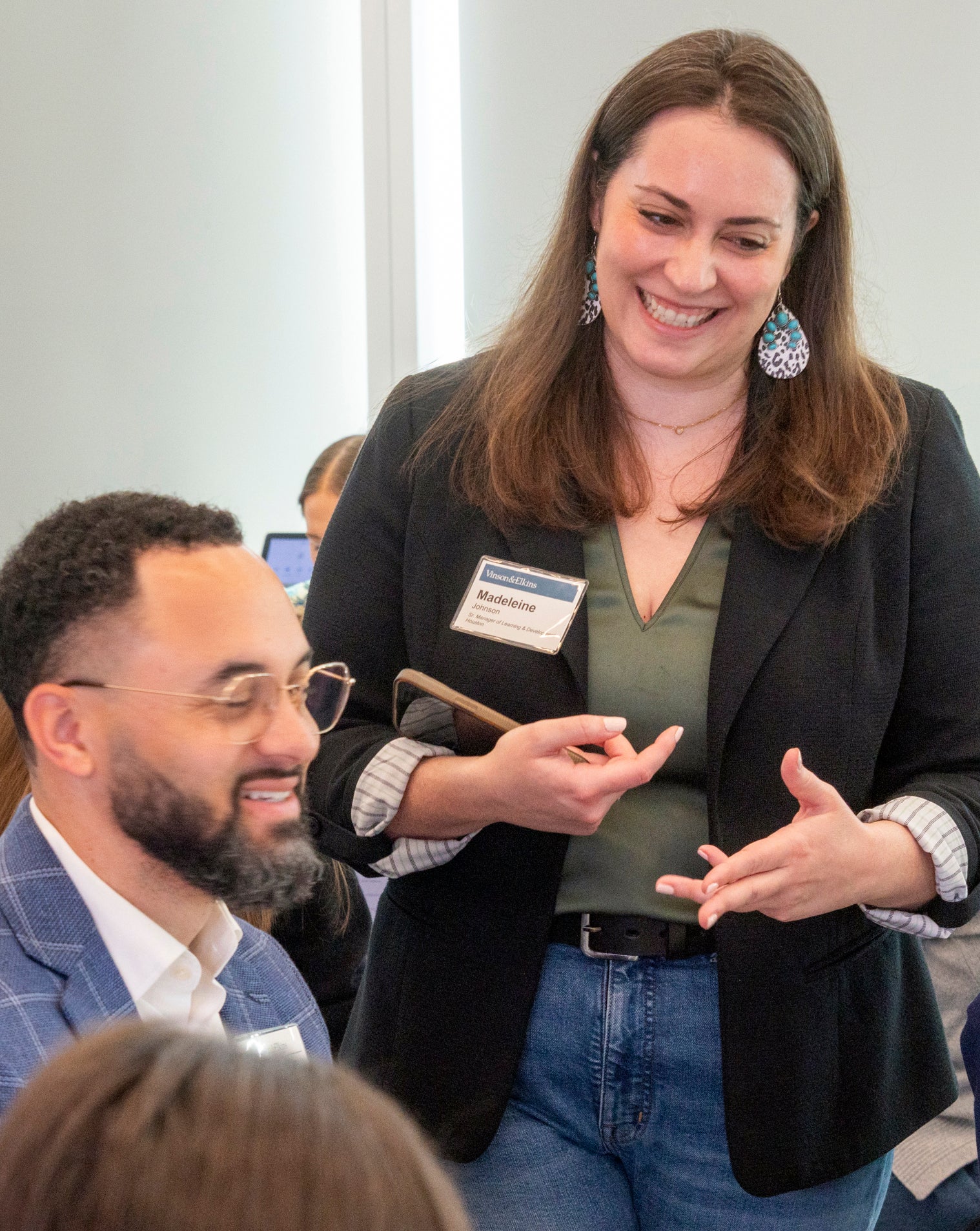
Vinson & Elkins’ inaugural Mid-Level Associate Summit brought lawyers from across the firm to Houston for three days of learning and connecting. In this edition of V&E+, three of the summit’s organizers — Lina Dimachkieh (Lead Partner, Attorney Talent), Lisa Stockton (Senior Director of Attorney Talent), and Madeleine Johnson (Senior Manager of Learning & Development) — discuss the thinking behind the summit, the firm’s long-term talent investments, and keys to success in the mid-level role.
Vinson & Elkins just wrapped up its first firmwide summit for mid-level associates, and you each played a key role in organizing it. What should we know about the summit?
Lisa: The firm is always working to help our lawyers build their knowledge, sharpen their skills, and strengthen their connections with one another — at every stage of their career. This summit was a prime example of that work, looking in-depth at the responsibilities and opportunities that come with the mid-level role, and equipping associates with practical tools and insights to navigate it.
Lina: Right. The mid-level years mark a turning point — one where responsibilities expand, where growth accelerates — and guiding lawyers through it is a priority for our firm at the highest level. After a mid-level associate voiced interest in a program of this type to the firm’s chair, Keith Fullenweider, he came to us with a message to develop it, and Madeleine led the way from there.
Madeleine: Feedback on the summit has been excellent, and its success was the result of a collaborative effort from the entire Learning & Development team. Even going back to before the idea for the summit emerged, several key investments paved the way.
Investments in expanding the Learning & Development team, in encouraging perspectives from people with diverse backgrounds, in thinking strategically about how people prefer to engage and connect, in deepening the partnership’s role in talent initiatives, just to name a few. It’s all part of a long-term effort to position associates to succeed, and one that we continue to build on every day.
Let’s talk more about the new responsibilities you mentioned. How does success as a mid-level associate differ from success as a junior?
Lisa: In their first two years, associates focus primarily on building technical expertise — on learning the law, honing their craft, digging into details, understanding processes and their role in them. Task mastery is the name of the game.
But from the third year on, success begins to involve much more than legal work. You’re managing matters. You’re collaborating more closely with partners. You’re communicating with clients. You’re overseeing junior associates — training, delegating, and delivering feedback.
Madeleine: Balancing these new responsibilities — it’s a lot to think about, and it often requires an intentional shift in mindset. Elite work product, while still massively important, becomes table stakes. Thriving as a mid-level means zooming out and thinking about matters in their broader context, and owning them from start to finish.
Lina: When mid-level associates begin to shift their mindset, it’s like a lightbulb moment. They become more confident in these skillsets and more comfortable in their new role. I’ve seen this professional growth time and again with lawyers at our firm, and it’s always exciting to see.
I can imagine. But it’s difficult to grow without encountering some challenges along the way.
Lina: It is. One thing that some new mid-level associates struggle with is feeling like they need to do everything. Yes, you now face more demands for your time and attention. But meeting those demands means having to let go of some of the work you excelled at earlier in your career.
That takes some getting used to. Years ago, I fell into this same trap, thinking that it would be easier to just do everything myself. Had I not shifted my mindset, I would never have reached the role I’m in today.
Madeleine: It’s similar to the dilemma facing players on a sports team. If you play soccer, for example, you can’t score every goal, save every shot, and run the midfield all at the same time, even if you’re the team’s most talented player. In fact, trying to do everything is more likely to harm your team than help it.
Leaders on the playing field use their knowledge, skill, and experience to identify areas for improvement, create opportunities for others, and make their teammates better in the process. It’s no different for leaders in the legal field.
So, would it be fair to say that strong mid-level associates are smart delegators?
Lina: Absolutely — and that involves integrating training into the work you assign. When you maintain a teaching-focused dialogue with the associates you’re managing, you create more learning opportunities for them, your relationship with them strengthens, and the team as a whole grows more collaborative.
The value of this dialogue really shows up in high-pressure, fast-turnaround situations. The more intentional you are about helping develop junior associates, the more you can count on them to deliver quality work in a crunch, and the better able your team will be to deliver the excellent client service our firm is known for.
Lisa: Smart delegation generally entails more work upfront. As I often remind mid-level associates, some tasks could take longer than usual to complete, because they’re teaching people how to do the tasks at the same time. That can feel counterproductive in the moment, but it pays big dividends in the long run.
When you incorporate teaching into delegating, you’re not only accelerating your colleagues’ professional growth. You’re also freeing yourself to focus more attention on management, and strengthening the firm’s ability to serve clients. It really is a win-win-win proposition.
You each dedicate a lot of time helping mid-level associates develop their skills, but in different capacities. What’s one skill that you like to emphasize?
Madeleine: Thinking ahead. While near-term deadlines will always drive work, forward-thinking lawyers look long-term whenever they can. They consider how an internal decision might impact team dynamics. How a matter outcome could affect a client a year from now — not just today or next week. How a client’s legal needs in one area might evolve to create a business opportunity for the firm in another.
Lisa: For me, it’s being fully engaged. Instead of zeroing in exclusively on your piece of a deal or case — and then moving on to the next assignment — sharp mid-level associates engage in the matter as a whole.
Now, to Lina’s earlier point, engagement doesn’t mean doing all the work. It means immersing yourself in the matter as it develops — tracking progress, managing workflow, and lending colleagues your time, energy, and expertise. It means staying vigilant to hidden risks, and speaking up with solutions when challenges arise.
Lina: I agree — thinking ahead and being fully engaged are critical to a mid-level associate’s development. I would also like to emphasize firm citizenship. By this I mean, contributing to the firm beyond billable work — for example, through recruiting, business development, knowledge management, community initiatives, or pro bono matters. So much growth comes from activities like these, and dedicating yourself to them can go a long way toward enhancing your career and finding community within the firm.
Love all of these — and how important learning and development is to Vinson & Elkins more generally.
Madeleine: It’s a big part of our culture. In every practice group, partners are deeply invested in the firm’s talent initiatives — not just through recruitment and evaluation, but by allocating work opportunities, leading training sessions, and ensuring that every associate has a constructive mentoring relationship with a partner or counsel.
Lisa: The Attorney Development team works alongside these Talent Lead partners, focusing on onboarding, mentoring, coaching, career planning, skills development, and more. The type of support our associates are looking for — and the level of it — ranges widely, and we tailor our support to their individual needs and goals.
Lina: Exactly. When you treat people as individuals — and not as a monolith — the support you provide is more likely to set them up for success. That’s one of the guiding principles behind our talent initiatives, and one of the many things that makes our firm a special place to work.
This information is provided by Vinson & Elkins LLP for educational and informational purposes only and is not intended, nor should it be construed, as legal advice.
Join leading practitioners and industry voices for a timely discussion of the legal, regulatory, and governance developments shaping the next proxy season.
Chambers UK 2027 has ranked Vinson & Elkins in Construction: Contentious (London Firms); Construction: International Arbitration (UK-wide); Energy & Natural …
Vinson & Elkins Chair Keith Fullenweider and Vice Chair Hilary Preston, alongside partners Creighton Smith and Jenny Speck, sit down for conversation on a global soccer tournament, the firm’s support for it, and their experience as spectators and volunteers.
At a recent Practising Law Institute (PLI) webinar on antitrust, over 250 legal professionals joined to hear from three antitrust leaders at Vinson & Elkins: Nicole Castle, Zach Terwilliger, and Craig Seebald. In this Q&A, they explore what’s changing in enforcement, how companies can spot risks early, and what it takes to build a strong compliance culture.
Please note that any communication with Vinson & Elkins via e-mail through this website does not constitute or create an attorney-client relationship with V&E. Please do not send any confidential information. A conflicts-of-interest procedure must be completed by V&E prior to establishment of an attorney-client relationship. When you execute an engagement letter from V&E you will be our client, and you may then exchange information freely with a V&E attorney.
By clicking “Accept,” you agree that we may review any information you transmit to us. You recognize that our review of your information, even if it is highly confidential and even if it is transmitted in a good faith effort to retain us, does not preclude us from representing another client directly adverse to you, even in a matter where that information could and will be used against you.