The Texas Business Court’s second year is off to a faster start than its first, and the expansion of its jurisdictional reach through House Bill 40 appears to be contributing to the uptick in its caseload.
As discussed in prior coverage of House Bill 40, which became effective Sept. 1, 2025, the jurisdiction-expanding legislation lowered the value threshold to qualify as a “qualified transaction” from $10 million to $5 million; lowered the related amount-in-controversy threshold from $10 million to $5 million; provided jurisdiction over a broad range of intellectual property disputes; provided jurisdiction to enforce arbitration agreements and review arbitral awards in most cases where the underlying claim would otherwise fall within the Business Court’s jurisdiction; and allowed pre-Sept. 1, 2024 cases to be transferred to the Business Court when there is agreement between the parties and the Business Court. House Bill 40 also allows the amount in controversy threshold in certain types of cases to be met by aggregating the total amount of all joined parties’ claims.
From its inception Sept. 1, 2024, through the end of the first quarter of 2026, the Business Court received approximately 367 cases through either original filings or removals. Close to half of those cases were added after the effective date of House Bill 40. In the Eleventh (Houston) Division, the Business Court received nearly as many cases since House Bill 40 went into effect as it did during its entire first year. In the Third (Austin) Division, the Business Court received even more cases since House Bill 40 went into effect than it did during its first year of operation.
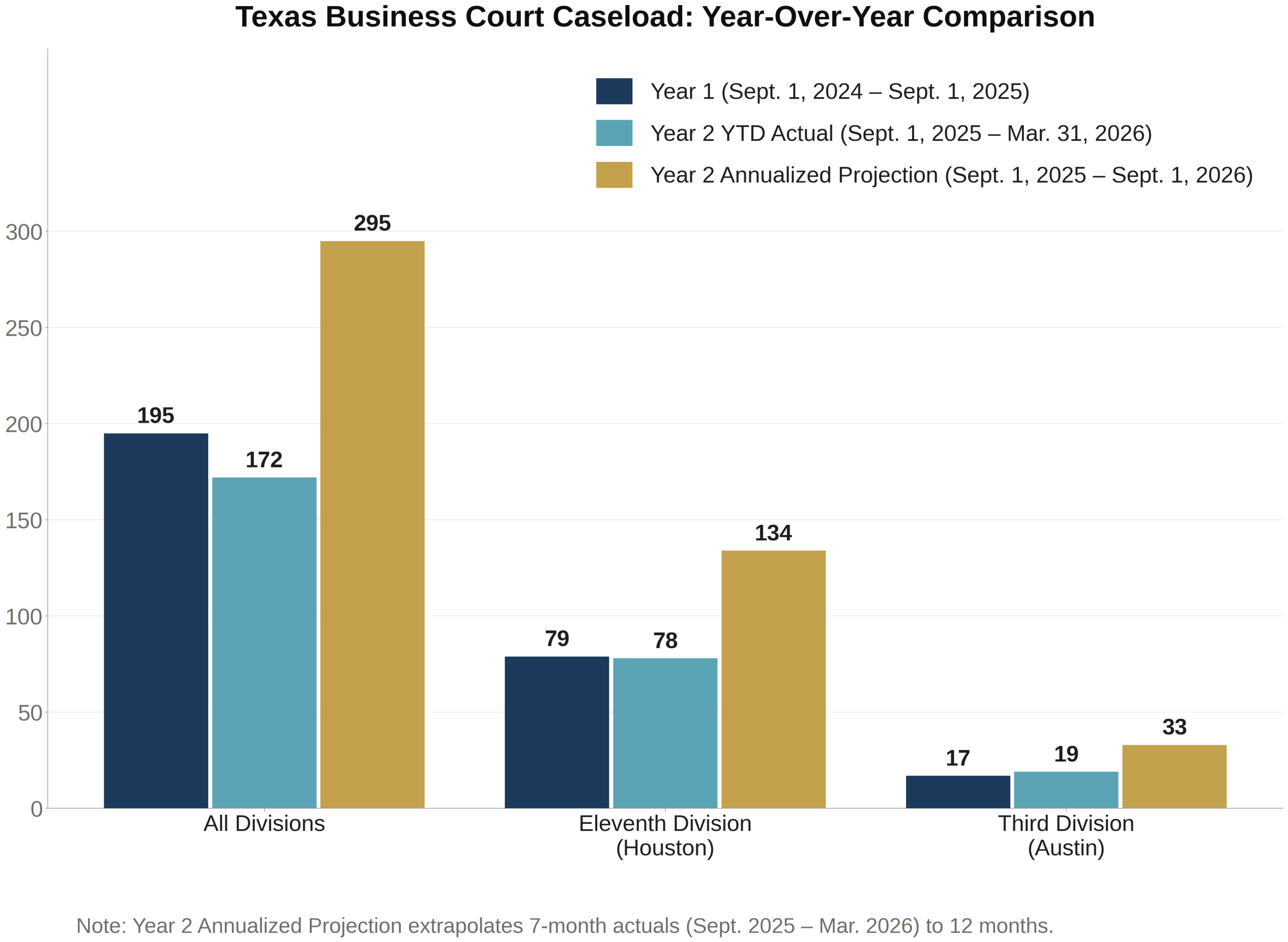
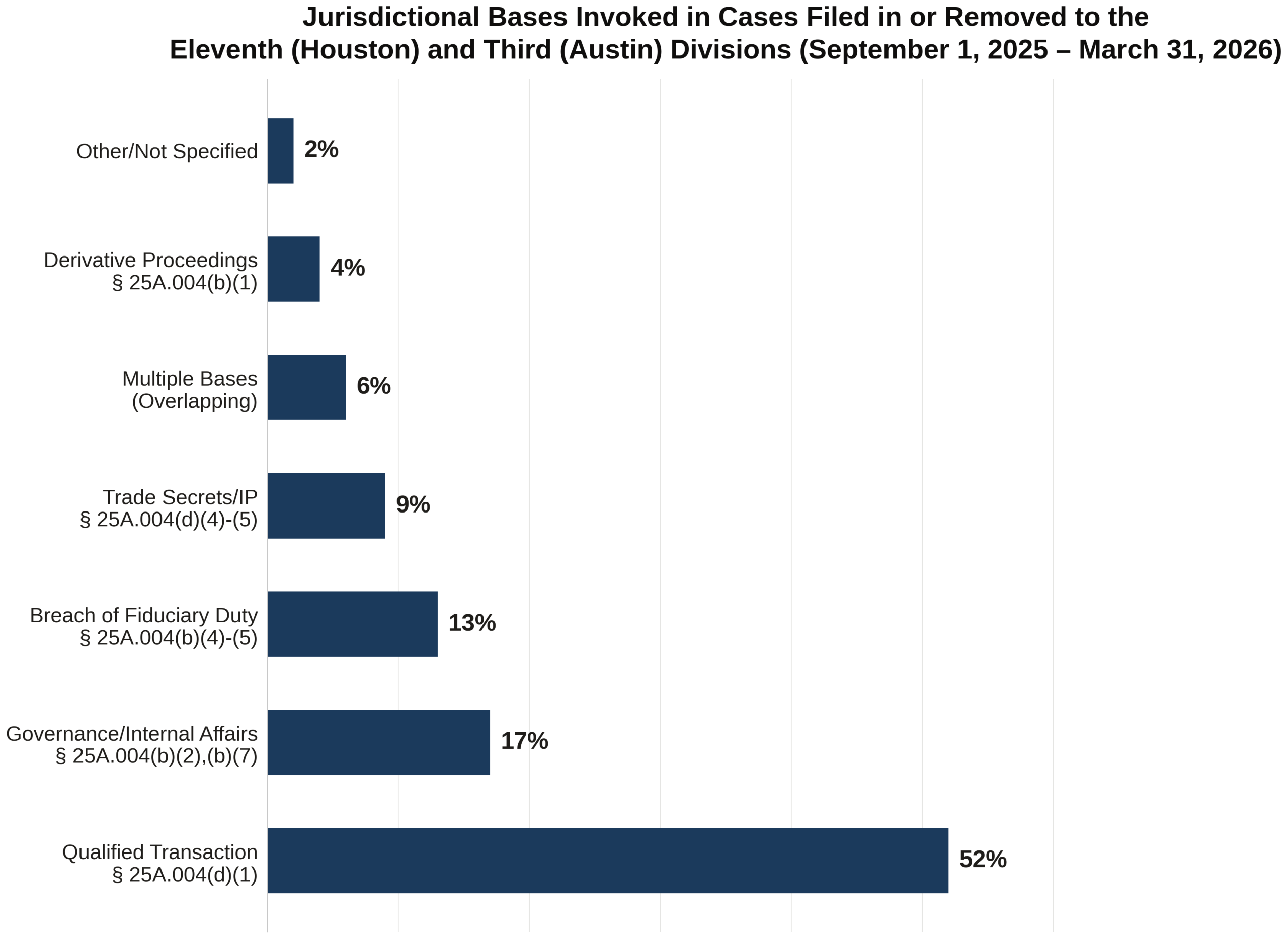
The cases being filed in or removed to the Eleventh and Third Divisions of the Business Court in the post-House Bill 40 period reflect both continuity with the Business Court’s first-year docket and early signs that, as intended, House Bill 40 is broadening the types of disputes reaching the Business Court.
Early jurisdictional trends from Sept. 1, 2025, through March 31, 2026, in the Business Court’s Eleventh and Third Divisions indicate that the “qualified transaction” basis under Section 25A.004(d)(1) has emerged as the most frequently invoked jurisdictional ground. Tex. Gov’t Code § 25A.001(14) defines “qualified transaction” as a transaction or series of related transactions under which a party either (a) pays or receives or is obligated to pay or is entitled to receive consideration with an aggregate value of at least $5 million or (b) lends, advances, borrows, receives, is obligated to lend or advance or is entitled to borrow or receive money or credit with an aggregate value of at least $5 million. Governance and internal affairs disputes, breach of fiduciary duty claims against controlling persons, trade secret actions and derivative actions round out the remaining jurisdictional categories, with many filers asserting multiple overlapping bases to insulate against jurisdictional challenges.
Between the two divisions evaluated, the Eleventh Division has received the vast majority of original filings, reflecting a continued concentration of commercial activity — particularly in the energy sector — in the Houston metropolitan area. Removals from district court and original filings in the Eleventh and Third Divisions have been roughly balanced, though removals initially outpaced original filings as defendants moved quickly to leverage House Bill 40’s lower thresholds, the statutory claim-aggregation rule and the expanded ability to remove or transfer pre-Sept. 1, 2024, cases to the Business Court. As plaintiffs have become more familiar with the Business Court’s expanded jurisdiction, original filings have also increased, and litigants are beginning to test the Business Court’s jurisdictional boundaries in novel contexts, including employment-related qualified transaction claims and domestication of foreign judgments. As the Business Court gains traction, and high profile companies continue to redomicile in Texas, we can expect this increase in filings to continue through the end of 2026.
Texas Business Court Data
- Total number of cases filed in the Texas Business Courts since they opened through Q1 2026 (Sept. 1, 2024 – March 31, 2026): 367
- Total number of cases filed in the Texas Business Courts since the rules changed through Q1 2026 (Sept. 1, 2025 – March 31, 2026): 172
- Total number of cases filed in the Eleventh Division (Houston) of the Texas Business Courts since they opened through Q1 2026 (Sept. 1, 2024 – March 31, 2026): 157
- Total number of cases filed in the Eleventh Division (Houston) of the Texas Business Courts since the rules changed through Q1 2026 (Sept. 1, 2025 – March 31, 2026): 78
- Total number of cases filed in the Third Division (Austin) of the Texas Business Courts since they opened through Q1 2026 (Sept. 1, 2024 – March 31, 2026): 36
- Total number of cases filed in the Third Division (Austin) of the Texas Business Courts since the rules changed through Q1 2026 (Sept. 1, 2025 March 31, 2026): 19
Data on filings was compiled from publicly available sources and, as a result, may not be complete. AI analytics were used in evaluating trends from that data.
This information is provided by Vinson & Elkins LLP for educational and informational purposes only and is not intended, nor should it be construed, as legal advice.