On August 7, 2026, the Committee on Foreign Investment in the United States (“CFIUS”) released its Annual Report to Congress for calendar year 2025 (“2025 Report”). The 2025 Report shows that CFIUS remained highly active in a year that was materially disrupted by multiple U.S. government funding lapses, which tolled statutory review timelines for CFIUS’s ongoing cases and delayed CFIUS’s ability to accept new filings. Despite such operational disruptions, the 2025 Report’s figures show that CFIUS reviewed a significant number of transactions in 2025, with many metrics remaining broadly consistent with recent years.
Our key takeaways from the 2025 Report are summarized below. In sum, the 2025 Report does not reveal a significant shift in CFIUS’s substantive national security priorities or the rates or manner in which it is addressing national security concerns, though it does show some impacts from the government shutdowns last year. Most notably, parties demonstrated an increased reliance on using the short-form Declaration filing, but this approach was less successful than in prior years.
Continuities. CFIUS’s core approach appears to remain largely unchanged from recent years. The 2025 Report reflects a stable number of transactions reviewed, a steady Notice volume, consistent rates of moving cases to investigation and using mitigation, and a sustained focus on transactions involving critical Technologies, critical Infrastructure, and sensitive personal Data (TID) U.S. businesses as well as investments from China.
More Declarations, less success. The 2025 Report reveals a recent shift in parties’ filing strategy in favor of the short-form Declaration filing, though with less success than in prior years. While the number of transactions CFIUS reviewed remained relatively flat (347 transactions in 2025, 325 transactions in 2024, and 342 transactions in 2023), as did the number of Notice filings (207 in 2025, 209 in 2024, and 233 in 2023), the number of Declarations (140) was significantly higher than in 2023 (109) and 2024 (116). However, the increase in the number of Declarations coincides with a lower “success rate” in terms of filing outcomes. Only ~66% of Declaration filings were cleared at the end of the 30-day assessment in 2025, compared with 2023 (~76%) and 2024 (~78%). And, in ~26% of cases, CFIUS asked the Declaration parties to file a long-form Notice filing at the conclusion of the Declaration process, increased from 2023 (~18%) and 2024 (~15%).
Overall, the 2025 Report shows an increased reliance on Declarations as a filing strategy last year, and the lower Declaration clearance rate and higher Notice request rate at the conclusion of the Declaration process show that a larger number of transactions ultimately went through both the Declaration and Notice review processes, leading those transactions to undergo a longer CFIUS review period overall. Parties should heed these figures in determining whether to make a Declaration filing in the future, or simply proceed directly to a Notice filing, potentially shortening the overall review timeline.
More withdraw and refiles. The 2025 Report identifies an increase in the number of “withdraw and refile” Notices made with CFIUS. The proportion of Notice filings that were withdrawn and refiled increased to ~25% in 2025, compared with 20% in 2024 and 19% in 2023. These figures show that a larger number of transactions required additional review time or extensive mitigation discussions. This could be due to delays from the government shutdowns, more complex transactions, or both.
Increased use of extraordinary investigation extension. The 2025 Report identifies a meaningful increase in the number of times that CFIUS invoked its authority to extend an investigation period for 15 days in “extraordinary circumstances.” This authority was invoked eight times in 2025 (~7% of total investigations), compared with twice in 2024 (~2% of total investigations) and once in 2023 (~1% of total investigations). Similar to the “withdraw and refile” trend, the increased use of extraordinary extensions and review beyond the ordinary statutory timeline may reflect both transaction complexity and operational disruptions at CFIUS caused by government shutdowns.
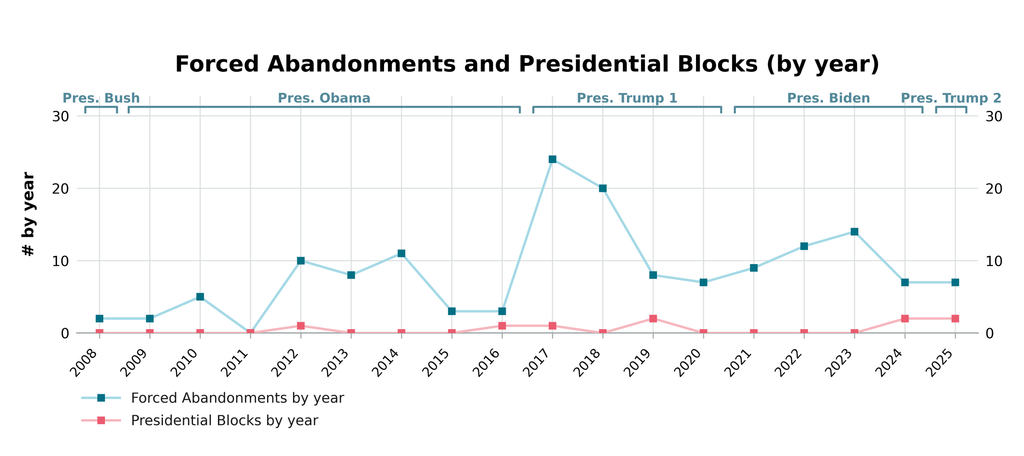
Steady rate of effectively blocked transactions. The 2025 Report states that nine transactions were effectively blocked by CFIUS in 2025 (seven abandoned because national security concerns could not be resolved and two transactions subject to presidential action). This follows a broader trend of approximately 10 effectively blocked transactions every year for the past five years, as shown in the chart below.
Decrease in non–notified activity. CFIUS’s non-notified enforcement activity declined in 2025, with CFIUS opening 62 formal inquiries and requesting filings for 9 transactions, down from 76 inquiries and 12 filing requests in 2024. With enforcement remaining a stated priority of CFIUS, this decrease in non-notified activity may be due to more parties with relevant transactions opting to file, operational disruption from the government funding lapses and the related need to consolidate resources to support other CFIUS operations, or both.
No observable trend in frequency of mitigation. The 2025 Report shows no observable trend in the number of National Security Agreements or other mitigation agreements used by CFIUS to mitigate national security concerns. In 2025, ~12% of Notices were subject to mitigation, significantly down from 21% in 2023, but up from 8% in 2024. The Trump Administration in its America First Investment Policy stated a goal to “cease the use of overly bureaucratic, complex, and open-ended ‘mitigation’ agreements.” We have yet to see whether there will be fewer mitigation agreements through President Trump’s second term than in prior presidential administrations, but based on the figures provided in the 2025 Annual Report, roughly the same number of mitigation agreements were terminated (23) as became effective (25) in 2025, reflecting relative stability in the termination of outdated mitigation agreements over prior years (25 in 2024 and 15 in 2023).
Countries of Foreign Investors Filing. Similar to recent years, China was the largest source country for Notice filings (~17%, with 33 Notices in 2025), but Japan was the largest overall filer of Notice and Declaration filings (~12%, with 41 total filings in 2025). In 2023 and 2024, China was also the largest source country for Notice filings (14% in 2023 and 12%, in 2024). In 2024, Japan was also the largest overall filer (12%). In 2023, China was the largest source country with the largest number of overall filings (9%).
This information is provided by Vinson & Elkins LLP for educational and informational purposes only and is not intended, nor should it be construed, as legal advice.
Join leading practitioners and industry voices for a timely discussion of the legal, regulatory, and governance developments shaping the next proxy season.
Chambers UK 2027 has ranked Vinson & Elkins in Construction: Contentious (London Firms); Construction: International Arbitration (UK-wide); Energy & Natural …
Vinson & Elkins Chair Keith Fullenweider and Vice Chair Hilary Preston, alongside partners Creighton Smith and Jenny Speck, sit down for conversation on a global soccer tournament, the firm’s support for it, and their experience as spectators and volunteers.
Please note that any communication with Vinson & Elkins via e-mail through this website does not constitute or create an attorney-client relationship with V&E. Please do not send any confidential information. A conflicts-of-interest procedure must be completed by V&E prior to establishment of an attorney-client relationship. When you execute an engagement letter from V&E you will be our client, and you may then exchange information freely with a V&E attorney.
By clicking “Accept,” you agree that we may review any information you transmit to us. You recognize that our review of your information, even if it is highly confidential and even if it is transmitted in a good faith effort to retain us, does not preclude us from representing another client directly adverse to you, even in a matter where that information could and will be used against you.